Software development is entering a new era. The question is no longer simply whether developers use artificial intelligence, but how much of the development process they can successfully delegate to AI agents.
For decades, software engineers have been evaluated primarily on their programming skills, technical expertise, and ability to design and maintain applications.
Today, a new category of professionals is emerging: AI-First Software Engineers.
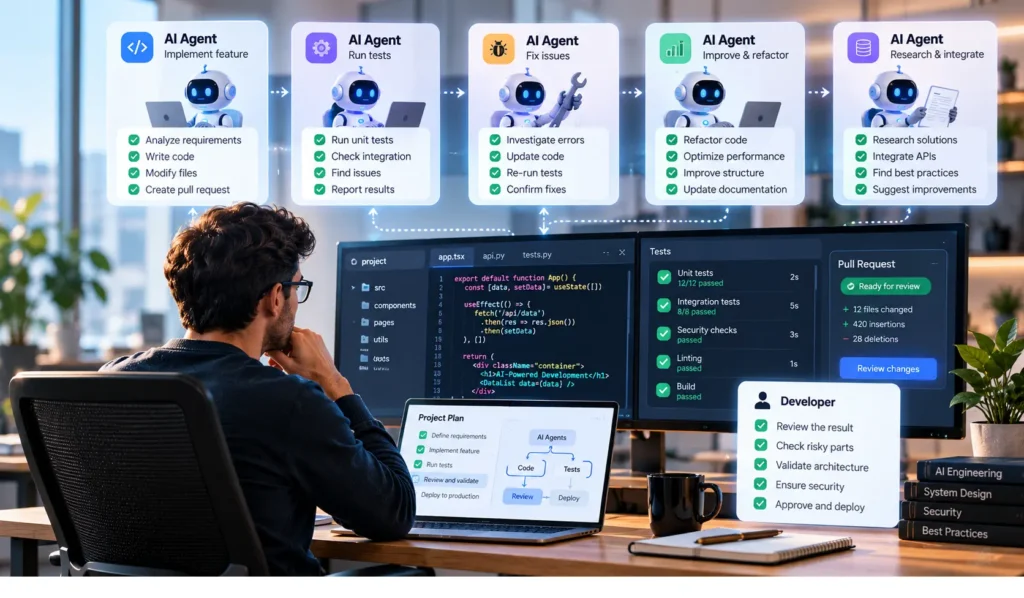
These developers don’t necessarily write every line of code themselves. Instead, they use AI agents to implement features, modify existing applications, generate tests, investigate bugs, and automate development workflows.
The developer’s role increasingly shifts toward defining requirements, making architectural decisions, supervising AI agents, and validating the final results.
At Web Recruiters, we are already observing this change in actual recruitment requests. Some employers are explicitly looking for engineers who allow AI agents to perform most of the coding while retaining human oversight of quality, security, and critical technical decisions.
This raises an important question:
Are we moving from an era of developers who write code to an era of developers who manage systems that write code?
1. Three Types of Software Developers in the AI Era
The adoption of artificial intelligence is creating three broad approaches to software development.
These categories represent different working methods rather than levels of seniority or technical competence.
Traditional Developers: Writing Code Manually
Traditional developers primarily rely on their programming knowledge, development environments, documentation, and established engineering practices.
They write, debug, test, and maintain code themselves, with little or no assistance from generative AI.
Their strengths often include deep familiarity with programming languages, direct control over implementation, and a detailed understanding of the systems they build.
Traditional development remains relevant, particularly in environments involving strict security requirements, specialized technologies, legacy systems, or restrictions on external AI services.
However, as AI tools become more capable, developers who avoid them entirely may face increasing pressure to demonstrate competitive productivity.
AI-Assisted Developers: AI as a Productivity Tool
The second category includes developers who actively use AI to accelerate specific programming tasks.
They might use ChatGPT, Claude, GitHub Copilot, Cursor, or similar tools to:
Generate code snippets and individual functions.
Explain unfamiliar code.
Suggest improvements and refactoring opportunities.
Write unit tests and documentation.
Identify bugs and troubleshoot errors.
Accelerate routine development tasks.
The developer still controls most of the implementation process and frequently writes or modifies code manually.
In this model, AI acts primarily as an assistant.
AI-First Developers: AI Agents as the Primary Implementers
The third category represents a more fundamental change.
AI-first developers organize their workflows around autonomous or semi-autonomous AI coding agents.
Instead of manually implementing every feature, they describe the desired outcome, provide technical context, establish constraints, and delegate implementation to agents.
An AI agent may independently inspect a repository, modify multiple files, run tests, identify errors, and attempt corrections.
The developer then reviews the outcome, evaluates technical decisions, and intervenes where necessary.
The defining characteristic of AI-first development is not simply using AI tools. It is designing a development process in which AI agents perform substantial implementation work.
Importantly, these approaches are not mutually exclusive. An experienced engineer may use agentic workflows for routine implementation while manually handling particularly sensitive or complex components.
2. From Writing Code to Managing AI-Driven Development
One of the most significant changes in software engineering is the redistribution of responsibilities between developers and AI systems.
In traditional development, engineers directly perform most implementation tasks.
In AI-first development, they increasingly become coordinators, reviewers, and technical decision-makers.
A typical AI-driven workflow might include the following stages.
Step 1: Define the business requirements
The engineer analyzes the business problem, identifies the expected functionality, and establishes acceptance criteria.
Step 2: Design the technical approach
The engineer determines architectural constraints, integration requirements, data structures, and implementation priorities.
Step 3: Delegate implementation to AI agents
AI coding agents receive instructions, access the relevant project context, and begin implementing the required functionality.
Step 4: Execute automated validation
The development environment runs tests, linters, static analysis, and other automated quality checks.
Step 5: Review results and critical risks
The engineer examines the generated changes, evaluates architectural decisions, and pays particular attention to security-sensitive or business-critical functionality.
Step 6: Approve, improve, or repeat
Depending on the results, the engineer approves the implementation or instructs the agents to make further changes.
This approach can reduce the amount of routine coding performed manually.
However, successful implementation still depends on the engineer’s ability to understand the system, evaluate the output, and recognize problems that automated checks may miss.
3. What Employers Are Looking for in AI-First Developers
The requirements for AI-first engineering positions are evolving beyond traditional programming skills.
Strong knowledge of programming languages, frameworks, databases, and software architecture remains important.
But employers are increasingly adding requirements related to AI-driven workflows.
Experience with AI Coding Agents
Candidates may be expected to demonstrate practical experience with tools such as:
Claude Code
OpenAI Codex
Cursor
GitHub Copilot
Other autonomous or agentic coding environments
Employers want to understand how candidates use these tools in real development projects rather than simply whether they have tried them.
Agentic Development Workflows
Relevant experience may include:
Delegating complex programming tasks to AI agents.
Managing multiple AI agents or parallel development tasks.
Providing agents with repository context and technical instructions.
Automating testing and validation.
Handling agent failures and incorrect implementations.
Building repeatable AI-driven development workflows.
Code Review and Risk Management
AI-first developers must be capable of reviewing AI-generated code and identifying potential problems.
Particular attention may be required for:
Authentication and authorization.
Application security.
Payment processing.
Database migrations.
Data privacy and protection.
Infrastructure configuration.
Performance-critical components.
Business logic and financial calculations.
The goal is not necessarily to manually review every generated line with equal intensity.
Instead, engineers must apply appropriate validation and risk-based review, ensuring that important failures are not overlooked.
Strong Software Engineering Fundamentals
AI-first development does not eliminate the need for engineering expertise.
Developers still need to understand software architecture, APIs, databases, cloud infrastructure, testing, debugging, and production operations.
Without these foundations, it becomes difficult to distinguish a technically sound AI-generated solution from one that merely appears to work.
4. AI Coding Experience vs. LLM Engineering: An Important Distinction
One of the most common sources of confusion in AI-related recruitment is the difference between using AI to develop software and developing software products that incorporate AI.
These are related but distinct skill sets.
AI-First Software Engineering
An AI-first software engineer uses AI agents as part of the software development process.
For example, a Fullstack Developer may use Claude Code or Codex to implement React components, create backend APIs, write tests, and refactor an existing application.
The resulting product does not necessarily contain any AI functionality.
LLM and AI Application Engineering
An LLM Engineer or AI Application Developer builds software that incorporates language models or other AI capabilities.
Relevant requirements may include:
Hands-on experience with OpenAI, Anthropic, or other LLM platforms.
Experience with AI agents, retrieval-augmented generation (RAG), tool calling, prompt engineering, or LLM evaluations.
Experience building conversational AI or workflow automation solutions.
Additional skills may include:
LLM API integration.
Embeddings and vector databases.
Structured model outputs.
Agent orchestration frameworks.
Model evaluation and monitoring.
Context management.
AI application security.
Cost and latency optimization.
A candidate may be highly experienced in AI-first development without having built an RAG application.
Similarly, an experienced LLM Engineer may develop AI-powered products without relying heavily on autonomous coding agents.
For employers and recruitment agencies, understanding this distinction is essential to identifying the right candidates.
Some positions genuinely require both skill sets, but they should not automatically be treated as interchangeable.
5. The Emergence of AI Harness Engineering
As developers move toward increasingly autonomous AI workflows, another area of expertise is becoming important: AI harness engineering.
An AI development harness is the surrounding infrastructure that enables coding agents to operate within a controlled and repeatable process.
Rather than manually interacting with an AI assistant for every task, engineers may build automated workflows that manage the entire development cycle.
A harness can include:
Task preparation and distribution.
Agent instructions and context management.
Access to repositories and development tools.
Automated testing and validation.
Error detection and retry mechanisms.
Security restrictions and execution boundaries.
Logging and monitoring.
Human approval checkpoints.
For example, an engineer might trigger a predefined workflow using a Bash script.
That workflow could launch coding agents, provide the necessary instructions, execute tests, collect results, and prepare the changes for review.
The engineer may interact with the automation system rather than directly typing instructions into Claude Code or Codex.
This introduces a new dimension to technical expertise.
The question is no longer only how effectively a developer uses an AI coding tool, but how effectively they design the entire environment in which AI agents operate.
A well-designed harness can make AI-assisted development more repeatable, observable, and manageable.
However, automation alone does not guarantee quality. The effectiveness of the system depends on its constraints, evaluation mechanisms, and human oversight.
6. How Should Companies Evaluate AI-First Developers?
Traditional technical interviews often focus on coding exercises, algorithmic problems, and framework-specific questions.
These assessments can still provide useful information.
However, evaluating AI-first developers may require additional methods.
A candidate’s ability to write code manually does not necessarily demonstrate their ability to manage AI agents effectively.
Likewise, the ability to generate large amounts of code with AI does not automatically indicate strong engineering competence.
Companies should consider evaluating several areas.
AI Workflow Design
Can the candidate explain how they organize an AI-driven development process?
How do they prepare requirements, manage context, and divide complex tasks?
Technical Decision-Making
Can the candidate justify architectural decisions and identify inappropriate solutions suggested by AI?
Code Validation
How does the candidate verify that generated code meets functional, security, and performance requirements?
Failure Handling
What happens when an agent introduces a bug, misunderstands requirements, or repeatedly fails to complete a task?
Engineering Independence
Can the candidate diagnose and resolve critical issues without depending entirely on AI-generated suggestions?
Delivery and Ownership
Can the candidate demonstrate completed projects and explain their personal contribution to the outcome?
One practical assessment could involve asking a candidate to implement a small feature using their preferred AI tools.
The evaluation would focus not only on the final code but also on how the candidate organizes the workflow, validates the results, identifies risks, and explains technical decisions.
The objective is to evaluate engineering judgment and delivery capability, not merely the number of prompts or lines of code generated.
7. How AI-First Development Could Change Software Engineering Teams
The growing capabilities of AI coding agents raise important questions about the future structure of software development teams.
If AI agents can independently perform more implementation tasks, companies may reconsider how engineering work is distributed.
Several developments are possible.
Smaller Teams Delivering More Functionality
Some projects may require fewer engineers to complete a given amount of implementation work.
However, the actual impact will depend on system complexity, quality requirements, and the effectiveness of AI workflows.
Greater Importance of Senior Engineering Judgment
As more code is generated automatically, architectural decisions, risk assessment, and technical oversight may become increasingly valuable.
Senior engineers may spend less time on routine implementation and more time designing systems and validating outcomes.
Changing Expectations for Junior Developers
AI agents can already assist with many tasks traditionally assigned to junior engineers.
This creates a challenge for engineering organizations: how can less experienced developers build practical expertise when routine implementation is increasingly automated?
Junior engineers may need to develop AI collaboration, testing, debugging, and system comprehension skills earlier in their careers.
New Engineering Specializations
Companies may increasingly seek professionals with expertise in agent orchestration, AI development infrastructure, evaluation systems, and automated software delivery.
These responsibilities may become part of existing engineering roles or develop into more specialized positions.
Productivity Must Be Measured by Outcomes
AI-generated code volume is not a reliable measure of engineering productivity.
More meaningful indicators include delivery time, defect rates, maintainability, operational reliability, and the total cost of developing and supporting software.
The long-term value of AI-first development will depend on measurable improvements in these outcomes.
8. How AI-First Development Is Changing IT Recruitment
For recruitment agencies, the emergence of AI-first engineering introduces new challenges.
Traditional candidate screening often relies on years of experience, programming languages, frameworks, and previous job titles.
These criteria remain relevant but may no longer provide a complete picture.
Two developers with similar technical backgrounds may have very different levels of experience with autonomous AI development.
One may use AI occasionally to generate code snippets.
Another may have built an automated development environment in which AI agents implement features, execute tests, and prepare changes for production review.
Their CVs may look similar, but their workflows and capabilities can be substantially different.
Recruiters therefore need to ask more specific questions.
How does the candidate use AI in daily development?
Which tasks are delegated to agents?
What level of autonomy do those agents have?
How are generated changes validated?
How does the candidate handle critical technical decisions?
What measurable results have they achieved?
These questions help distinguish basic familiarity with AI tools from meaningful experience in AI-driven software engineering.
9. Recruiting AI-First Developers with Web Recruiters
At Web Recruiters, we help companies identify and recruit software engineers with the technical expertise and practical experience required for modern development environments.
As AI becomes more deeply integrated into software engineering, we recognize the importance of evaluating candidates beyond traditional programming skills.
Depending on project requirements, companies may need:
AI-First Fullstack Developers.
AI-Assisted Software Engineers.
Agentic Software Developers.
LLM Engineers.
AI Application Developers.
Engineers experienced in AI workflow automation and agent orchestration.
Our recruitment approach focuses on understanding the client’s actual technical needs and identifying candidates whose experience matches those requirements.
Whether a company needs engineers who use AI to accelerate traditional development or specialists who build autonomous AI-powered systems, defining the right candidate profile is an essential first step.
Looking for AI-First Software Engineers?
Web Recruiters helps companies find and hire developers who combine strong software engineering expertise with practical experience in AI-driven development.
We support IT recruitment, staff augmentation, and dedicated development team requirements for companies across international markets.
Contact Web Recruiters to discuss your hiring needs and find the right AI engineering talent for your team.
Conclusion: The Future Developer May Write Less Code — but Take More Responsibility
Artificial intelligence is changing how software is designed, implemented, tested, and maintained.
For some developers, AI remains a productivity assistant.
For others, autonomous agents are becoming central to the entire development process.
The most significant transformation may not be the automation of coding itself, but the changing role of the software engineer.
Developers increasingly need to combine technical knowledge with the ability to direct AI systems, evaluate their output, and maintain responsibility for the software they deliver.
For employers, this creates new opportunities — and new hiring challenges.
For developers, it creates new ways to work, new skills to master, and new expectations to meet.
And for IT recruitment, it introduces an important question:
Will the most valuable software engineer of tomorrow be the person who writes the best code, or the person who builds the most effective system for AI agents to write, test, and maintain it?
The answer may depend on the project.
But one thing is becoming clear: understanding how developers work with AI is increasingly important when evaluating software engineering talent.